Construction sites ask questions that warehouses never have to answer. Can the machine run a full shift without a charge break? Can it climb a temporary ramp with a pallet of block? Can it sit idle in freezing weather and still start on the first turn of the key? For heavy outdoor assignments, the answers tend to point toward a diesel forklift.
The core reason is power density. Diesel fuel carries far more energy per unit of weight and volume than a battery pack, and that difference shows up in sustained heavy work. A diesel machine can run long shifts, handle continuous heavy loads, and refuel in minutes rather than hours. On a site where the schedule is driven by concrete pours and crane windows, that refueling time is not a minor convenience. It is a schedule variable.
This is not a claim that diesel is better in every setting. It is a claim that diesel is better matched to a specific set of conditions that construction sites produce regularly.
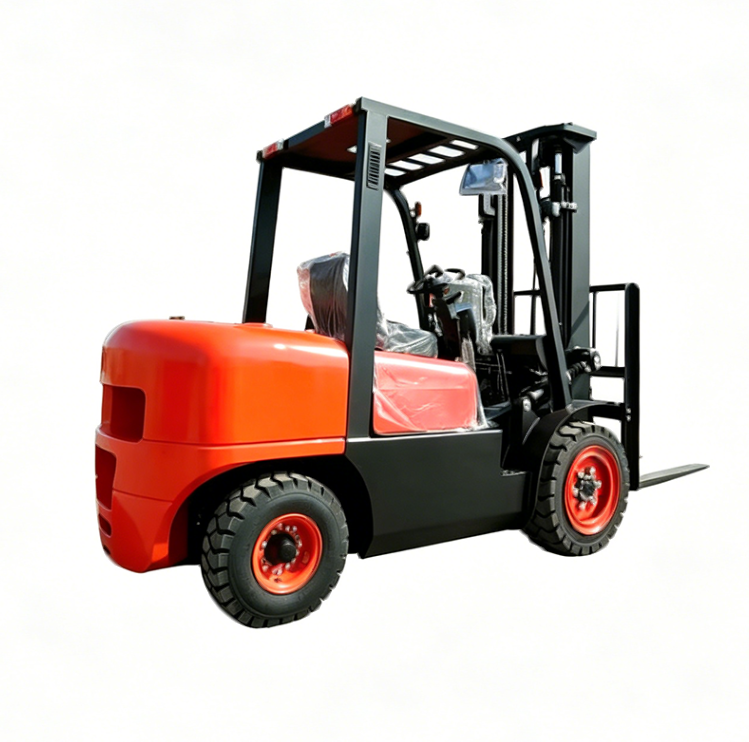
Construction sites are hostile to equipment in ways that are easy to underestimate. The ground is often unfinished, which means mud, gravel, ruts, and sudden soft spots after rain. A machine working these surfaces needs torque at low speed, ground clearance, and tires that can bite into loose material. Diesel engines deliver torque across a broad low-rpm band, which is exactly what is needed to crawl out of a rut with a load on the forks.
Weather adds another layer. Cold starts are a real issue for any equipment, and diesel engines have a long track record of reliable cold starting when properly specified with the right fuel and starting aids. Heat is less of a problem for the engine itself, though hydraulic systems and operators both feel it. Dust is constant, and diesel machines tend to tolerate dusty environments well because the engine and cooling systems are built with that exposure in mind.
The table below shows how the two power sources compare across the conditions construction sites actually produce.
| Condition | Diesel | Electric |
|---|---|---|
| Sustained heavy load | Strong, continuous output | Depends on battery state and duty cycle |
| Refueling or recharging | Minutes | Hours, unless battery swap is available |
| Cold weather starting | Reliable with proper setup | Battery capacity drops in cold |
| Uneven, muddy ground | High low-end torque | Adequate but less forgiving |
| Indoor air quality | Requires ventilation | No point-of-use emissions |
Many construction sites do not have reliable electrical infrastructure. Temporary power is often sized for tools and lighting, not for charging a fleet of forklifts. Running a dedicated charging circuit to a remote corner of a site can be expensive and slow to arrange. Diesel sidesteps that problem entirely. A fuel truck or a portable tank can service machines wherever they are working.
This logistics advantage compounds on large sites. If a machine has to travel back to a charging point, that travel time is lost production. If it can refuel in place, the machine stays near the work. On a multi-acre site with work fronts spread out, that difference adds up over a project.
There is a real cost side to this. Diesel fuel prices fluctuate, and emissions regulations in some jurisdictions restrict where diesel equipment can operate. Sites in dense urban areas or near sensitive receptors may face restrictions that make electric or alternative fuels a better fit. That is a legitimate constraint, not a reason to dismiss diesel outright.
The way a diesel engine delivers power is well suited to heavy lifting. Peak torque arrives at low engine speed, which means the machine can start a heavy load moving without revving hard or slipping a torque converter excessively. That characteristic matters when the load is at the edge of the machine's capacity and the ground is less than ideal.
Hydraulic systems on diesel forklifts are typically sized to match that torque profile, so the mast and attachment circuits have the flow and pressure needed for sustained heavy work. Electric machines have made significant progress here, and modern electric units handle heavy loads well in many applications. The difference is most pronounced in continuous heavy cycling, where the diesel machine's ability to keep working without a thermal or battery limit becomes the deciding factor.
A note on emissions standards: in markets where Tier 4 Final or equivalent regulations apply, modern diesel engines use aftertreatment systems that reduce particulate and nitrogen oxide emissions substantially compared to older designs. These systems add complexity and maintenance requirements, which is a tradeoff worth understanding before specifying.
A highway bridge project in the Pacific Northwest offered a clear illustration. The site was spread across a quarter mile of unfinished embankment, with material deliveries arriving at multiple points and no practical way to run charging infrastructure to each work front. The contractor had started with electric units for their quiet operation and lower operating cost per hour.
Within the first month, the pattern became clear. The electric machines were spending significant time traveling back to the charging point, and cold mornings were reducing available battery capacity enough that a full shift was not always achievable. The contractor brought in diesel units for the heavy outdoor work and kept the electric machines for the finishing work near the main staging area. The diesel machines stayed at the work fronts, refueled from a service truck, and the schedule stabilized.
The takeaway is not that one power source won. It is that the two were matched to different parts of the same job. That kind of mixed fleet is common on larger sites, and it reflects a practical reading of what each machine does well.
Diesel has clear limitations, and honest specification means acknowledging them. Indoor operation without adequate ventilation is not appropriate for diesel equipment. Enclosed spaces, tunnels under construction with limited airflow, and food processing or pharmaceutical environments all point toward electric or other alternatives.
Noise is another factor. Diesel engines are louder than electric drivetrains, and on sites near residential areas or hospitals, that noise can trigger complaints or operating restrictions. Fuel storage and handling also require attention, since diesel fuel has its own safety and environmental requirements.
None of these are reasons to avoid diesel equipment. They are reasons to match the machine to the site rather than to a general preference.
For sites working through that specification, sourcing from a manufacturer that produces across multiple equipment categories can simplify the process. KAIYITE builds forklifts, lifting platforms, and stackers with production capacity and engineering resources that support consistent quality and delivery. That range helps when a project needs more than one machine type to cover its full workload.

Shandong Kaiyite Machinery is an important participant in the construction machinery industry, located in a city known for well-known forklift brands such as Komatsu and Toyota. The factory covers an area of 128000 square meters and currently has over 1800employees, including 390 engineers.
Room 1314, 13th Floor, Block B, Zhongde Plaza, Liying Street, Rencheng District, Jining City, Shandong Province
 Wechat QRCode
 WhatsApp
Copyright © 2026 by Shandong Kaiyite Machinery Co., Ltd. Privacy Policy
 EN