The most visible job a container forklift handles in a port or freight-station yard is repositioning loaded boxes. This is not a simple pick-and-place task. Containers arrive on chassis, get staged in stacks, and need to move again when a vessel call changes or a rail cut is revised. Each of those moves involves lifting a load that is heavy, long, and often off-center relative to the fork pockets.
The reach capability is what separates this machine from a standard counterbalance truck. Container forklifts are built with masts and carriages that can extend far enough to pick a box from the second or third row without repositioning the whole machine. In a yard where every extra maneuver costs time and fuel, that reach translates into fewer moves per box.
What makes this suitable for the port environment comes down to a few factors:
Loads are uniform in dimension but variable in weight, requiring stable handling across a wide range
Ground surfaces are typically hard and engineered, but expansion joints and rail spurs create interruptions
Weather exposure is constant, so corrosion resistance and sealed components matter
Cycle times are long, so thermal and hydraulic endurance affects throughput
The counterbalance design still applies, but the frame, mast, and hydraulic system are built for sustained container cycling rather than occasional lifts.
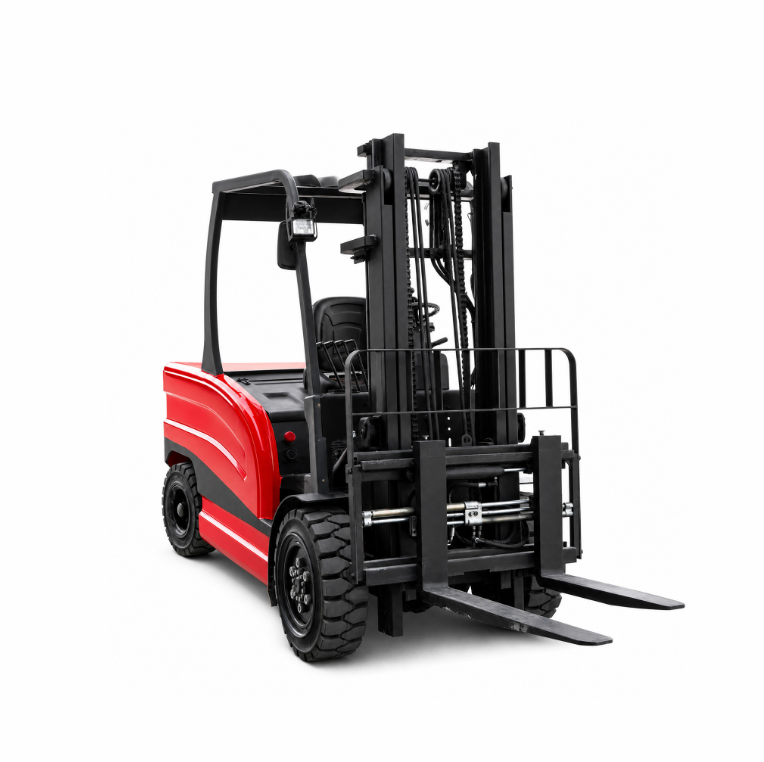
Container forklifts earn their keep at the interface between yard and transport. A truck pulls in with a chassis-mounted container, and the machine lifts it off, stages it, and later places it onto another chassis or a rail wagon. This sounds straightforward until the geometry of the vehicle is considered. A chassis sits at a height that requires a specific approach angle, and a rail wagon presents a narrower target with less tolerance for misalignment.
The loading operation has its own constraints:
The container must be centered on the chassis or wagon before the twist locks engage
Approach speed matters because a misaligned box can damage the vehicle or the container corner castings
Load center shifts as the container is picked from one end or the other, requiring attention to the load chart
Ground conditions at the loading point may differ from the main yard surface
These tasks are where operator skill shows most clearly. A machine with the right capacity and reach still needs an operator who understands how the load center changes during the lift and how the vehicle will react to the weight.
Container forklifts do more than move boxes. They support the yard planning function by enabling efficient stacking and retrieval. A well-planned yard uses stack height to reduce the ground footprint, and the forklift is the tool that makes that stacking possible. Retrieval from a stack is where the challenge lies. Pulling a container from the middle of a stack requires the reach to get past the front row and the stability to handle the load at that extended position.
The comparison below shows how container forklift capabilities map to common yard tasks.
| Yard Task | Key Capability Needed | Practical Constraint |
|---|---|---|
| Repositioning loaded containers | Reach and capacity at load center | Stack density limits maneuvering |
| Loading chassis and wagons | Precise control at height | Vehicle positioning tolerance |
| Stacking and retrieval | Stability at extended reach | Ground bearing capacity |
| Empty container handling | Speed and maneuverability | Wind exposure on high stacks |
| Stripping and stuffing support | Attachment flexibility | Congestion in tight work zones |
Ground bearing capacity is worth calling out separately. A loaded container forklift concentrates enormous force on a small contact patch, and yard surfaces are typically engineered for that. Freight-station yards that were not designed for this equipment may need surface work before deployment.
Empty containers are lighter but not easy. Wind becomes a real factor because the box acts like a sail, and an empty container on a forklift at height can shift in a gust. Experienced operators account for this by limiting lift height during high-wind periods and by keeping the load as low as practical during travel.
Empty handling also involves a different economic logic. Because the load is lighter, cycle times can be shorter, and the machine can work at a pace that loaded operations cannot match. This is where the container forklift's maneuverability in tight rows becomes most valuable. Empty stacks are often packed more densely than loaded stacks, so the ability to turn and position in a narrow lane directly affects yard throughput.
A note on wind exposure: standards such as ISO 668 define container dimensions and rating, but wind effects on lifted containers fall outside that scope and are typically addressed through site-specific operating procedures. That is a good example of where equipment capability and yard policy have to work together.
Container forklifts are capable machines, but they have clear boundaries. A container forklift is not a reach stacker, and it is not an empty container handler. Those are separate equipment categories with different design priorities. A container forklift can perform many of the same tasks in lower-volume operations, but at high throughput the specialized machines pull ahead.
A few scenarios where a container forklift is the wrong choice:
High-volume container terminals where purpose-built handling equipment is standard
Lifting containers beyond the rated capacity at the required load center
Working in stack configurations that exceed the machine's stability envelope
Operating on surfaces that cannot support the ground pressure of a loaded machine
Honesty about these limits matters. Overpromising on capability leads to unsafe operation and shortened equipment life. The right approach is to match the machine to the actual task frequency and load profile.
Specifying a container forklift comes down to understanding the yard's actual workflow rather than the maximum theoretical load. A freight station that handles a few dozen containers a day has different needs from a port terminal moving thousands. The duty cycle, the stack height, the vehicle types, and the ground conditions all shape the specification.
One pattern worth noting from a project review at a river port in Southeast Asia: the yard had been using general-purpose heavy forklifts for container moves, and the operators were spending significant time repositioning the machine for each pick. Switching to units with proper reach capability reduced the number of machine movements per container, and the yard was able to work the same volume with less equipment congestion in the aisles. The change was not about raw capacity. It was about the machine fitting the task.
For operations working through that specification, sourcing from a manufacturer that produces across multiple equipment categories can simplify the process. KAIYITE builds forklifts, lifting platforms, and stackers with production capacity and engineering resources that support consistent quality and delivery. That range helps when a yard needs more than one machine type to cover its full workload.

Shandong Kaiyite Machinery is an important participant in the construction machinery industry, located in a city known for well-known forklift brands such as Komatsu and Toyota. The factory covers an area of 128000 square meters and currently has over 1800employees, including 390 engineers.
Room 1314, 13th Floor, Block B, Zhongde Plaza, Liying Street, Rencheng District, Jining City, Shandong Province
 Wechat QRCode
 WhatsApp
Copyright © 2026 by Shandong Kaiyite Machinery Co., Ltd. Privacy Policy
 EN