Walk into a typical light-industry plant or a retail distribution warehouse and the first thing that stands out is how little room there actually is. Aisles are often 8 to 10 feet wide, racking goes up three or four tiers, and the loading dock is shared with pallet jacks, hand carts, and people on foot. A full-size counterbalance truck simply does not fit that picture.
A small forklift solves a geometry problem before it solves a lifting problem. With a tighter turning radius and a shorter overall length, it can pivot inside an aisle that would force a larger machine to reverse out and try again. In retail backrooms, where seasonal stock arrives on mixed pallets and has to be broken down fast, that maneuverability translates directly into fewer damaged endcaps and less time spent repositioning.
The numbers back this up. Industry surveys of warehouse layouts consistently show that aisles under 10 feet account for a large share of light-industry and retail storage space, and equipment rated above roughly 5,000 pounds capacity generally cannot operate efficiently in those lanes without sacrificing rack density.
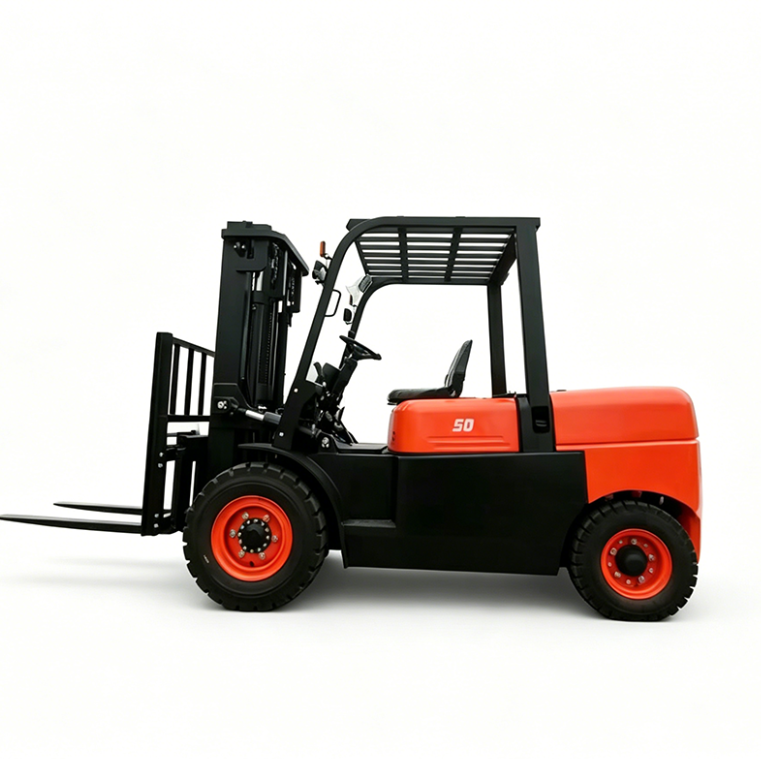
Light industry and retail rarely deal in the kind of tonnage that heavy manufacturing does. A typical retail distribution center might move pallets weighing 800 to 2,500 pounds, and a light-industry assembly plant might handle similar ranges with components, packaged goods, or finished consumer products. Paying for a machine rated at 8,000 or 10,000 pounds to move that kind of load is like using a semi truck to deliver mail.
The economics work out in a few directions:
Lower purchase cost, which matters when a facility needs three or four units instead of one
Lower fuel or battery consumption per shift, since the machine is not hauling around excess counterweight
Smaller footprint in the charging area or fuel bay
Easier transport between buildings when a facility operates multiple sites
There is a tradeoff worth naming honestly. A small forklift cannot substitute for a heavy truck when a genuinely heavy load shows up. Facilities that occasionally receive oversized freight still need access to a larger machine or an outside lifting service. Pretending otherwise leads to overloaded equipment and shortened service life.
Retail backrooms are some of the least forgiving spaces in material handling. Stockrooms are packed to the ceiling, aisles double as walkways, and deliveries arrive during business hours when customers are on the floor and staff are moving in every direction. A small forklift fits into that environment in a way that a larger truck cannot.
Consider a grocery distribution scenario. Pallets of bottled beverages, canned goods, and paper products arrive on mixed trailers. The receiving area might be 40 feet deep with racking on both sides and a single roll-up door. A compact electric truck can enter the trailer, pick a pallet, back out, turn inside the receiving area, and place the load without ever leaving the building footprint. A larger machine would need to stage loads outside, doubling handling time and exposing product to weather.
That kind of workflow is common enough that many retail chains now specify compact electric units as their standard receiving equipment. The logic is straightforward: fewer touches per pallet, less product damage, and a smaller training burden for staff who are not career forklift operators.
Most light-industry and retail facilities operate indoors, and indoor operation changes the power source calculation. Internal combustion engines produce carbon monoxide and other emissions that are not acceptable in enclosed spaces without extensive ventilation. Electric small forklifts sidestep that problem entirely, which is a major reason they dominate this segment.
Battery technology has improved enough that a single charge can cover a full shift in most light-duty applications, though cold storage and multi-shift operations may still need swap batteries or opportunity charging. The charging infrastructure is also simpler than it used to be. Modern chargers can plug into standard industrial power and do not require the dedicated ventilation systems that lead-acid banks once demanded.
The comparison below shows how the two power options stack up for typical indoor retail and light-industry use.
| Factor | Electric | Internal Combustion |
|---|---|---|
| Indoor emissions | None at point of use | Requires ventilation |
| Noise level | Low | Noticeably higher |
| Refueling time | Battery swap or charge cycle | Quick fuel fill |
| Maintenance complexity | Fewer moving parts | More frequent service |
| Suitability for cold storage | Requires specific battery spec | Generally workable |
For facilities that run multiple shifts or operate in freezer environments, the choice is not always clear-cut. Electric still works, but the battery specification and charging strategy need to be planned around the duty cycle rather than assumed.
A smaller machine is generally easier to train on, and that matters in retail and light industry where turnover is higher and operators may not run a forklift every day. The controls are similar across models, but the physical scale of a compact truck reduces the consequences of a misjudgment. A minor bump in a tight aisle with a small unit is usually just a bump. With a larger machine, the same error can collapse racking.
OSHA's powered industrial truck standard, 29 CFR 1910.178, requires training and evaluation for every operator, regardless of machine size. That requirement does not change. What changes is the practical risk profile. Compact trucks have shorter stopping distances, lower overall momentum at typical yard and aisle speeds, and a smaller blind spot footprint, all of which reduce the severity of common incidents.
That said, compact does not mean harmless. Tip-over remains the leading cause of fatalities involving powered industrial trucks, and a small forklift can still tip if a load is handled outside the rated load center or if the machine is driven too fast through a turn. The size advantage is real, but it does not replace discipline.
Specifying a small forklift for light-industry or retail work comes down to matching the machine to the actual duty cycle rather than the maximum theoretical load. A few practical criteria tend to matter most:
Load capacity at the actual load center being used, not just the headline rating
Turning radius relative to the narrowest aisle in the facility
Lift height against the tallest racking tier
Power source matched to indoor air quality requirements and shift length
Service network coverage, since downtime in a retail operation is expensive
One pattern worth noting from a project review at a regional retail distribution center in the Southeast: the facility had standardized on larger trucks for years, then switched to compact electric units for its receiving and put-away lanes. Within the first year, reported rack damage dropped noticeably and the receiving team's throughput per labor hour improved, largely because operators were no longer fighting the equipment in tight spaces. The change was not about speed. It was about fit.
For buyers working through that specification process, partnering with a manufacturer that builds both compact and larger counterbalance equipment can simplify the decision. KAIYITE produces material handling equipment across multiple categories, with production capacity and engineering resources that support consistent quality and reliable delivery for facilities of different sizes. That range matters when a single operation needs more than one type of truck.

Shandong Kaiyite Machinery is an important participant in the construction machinery industry, located in a city known for well-known forklift brands such as Komatsu and Toyota. The factory covers an area of 128000 square meters and currently has over 1800employees, including 390 engineers.
Room 1314, 13th Floor, Block B, Zhongde Plaza, Liying Street, Rencheng District, Jining City, Shandong Province
 Wechat QRCode
 WhatsApp
Copyright © 2026 by Shandong Kaiyite Machinery Co., Ltd. Privacy Policy
 EN