The first question at any heavy-goods site is not which machine to buy, but what is actually being lifted. A heavy duty forklift is defined less by a single number than by the combination of load weight, load center, lift height, and duty cycle. Two sites can both describe their work as "heavy" and end up needing very different machines.
Consider the difference between a steel service center handling bundled rebar and a precast concrete yard moving formwork panels. Both involve substantial weight, but the rebar bundles sit close to the carriage while the formwork panels extend far forward. That difference in load center changes the required capacity dramatically, often by a factor that surprises first-time buyers. Working through the load chart before committing to a capacity class is the step that prevents expensive mistakes later.
Heavy-goods work also tends to involve attachments, and attachments add their own weight and shift the effective load center further out. A coil ram, a bale clamp, or a rotating carriage all change the math. The machine has to be specified around the attachment, not the other way around.
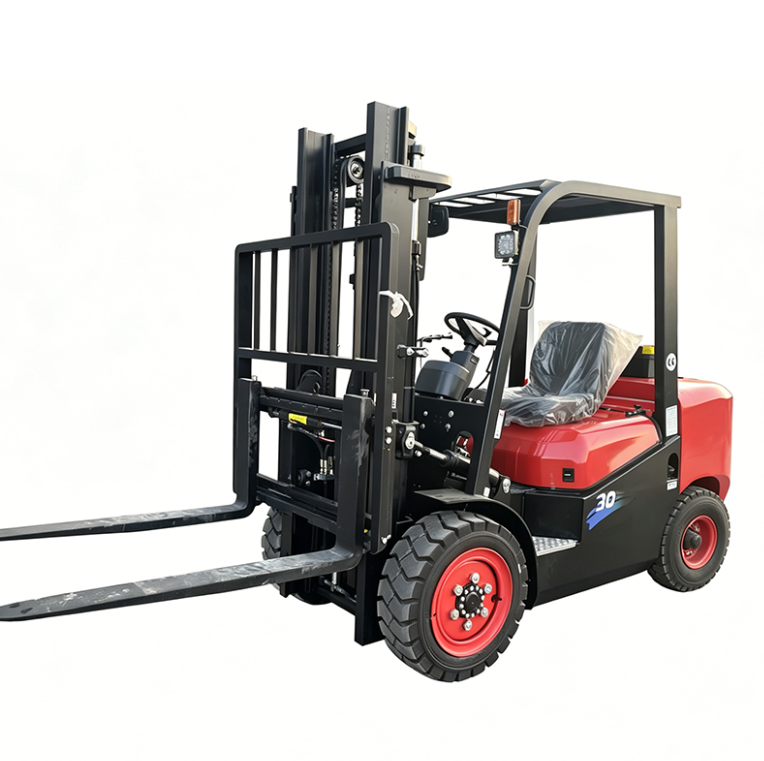
Steel yards are one of the most demanding environments for any lift truck. Coils, plate, structural shapes, and bundled bar stock all present challenges that go beyond raw weight. Coils in particular have a load center that shifts depending on how they are positioned, and a coil that rolls even slightly on the forks can destabilize the machine.
What makes this scenario suitable for a heavy duty forklift comes down to a few factors:
Loads consistently exceed the range where standard trucks remain stable
Travel surfaces are often uneven, with rail spurs and expansion joints
Outdoor operation exposes the machine to weather and temperature swings
Cycle times are long enough that thermal and hydraulic endurance matters
The counterbalance design still works here, but the frame, mast, and hydraulic system need to be built for sustained heavy cycling rather than occasional peaks. A truck that handles a heavy load once a day is a different machine from one that handles it every four minutes.
Ports and intermodal yards present a scenario where weight and reach combine. Containers, breakbulk cargo, and heavy machinery all move through these sites, often with tight scheduling and limited space between stacks. A heavy duty forklift operating here needs more than lifting capacity. It needs the reach to work into a container, the stability to handle off-center loads, and the durability to run across shifts.
OSHA's powered industrial truck standard, 29 CFR 1910.178, sets the baseline for operator training and load handling in these environments, and port authorities often layer additional requirements on top. The practical implication is that equipment selection and operator certification have to be planned together. A machine rated for the load is not sufficient if the operator has not been trained on the specific attachment and load type in use.
Empty container handlers and reach stackers are sometimes grouped into the same conversation, but they serve different functions. A heavy duty forklift with the right attachment can handle many container-related tasks, though it is not a direct substitute for a purpose-built container handler in high-volume operations. Matching the tool to the actual task frequency matters more than matching it to the biggest load on site.
Construction supply yards deal with loads that are heavy, awkward, and often irregular in shape. Precast panels, masonry cubes, pipe sections, and bundled lumber all fall into this category. The common thread is that the load is not a neat cube sitting on a standard pallet. It may be long, it may be off-center, and it may need to be rotated or tilted during placement.
Outdoor surfaces add another layer. Crushed stone, packed dirt, and temporary access roads all reduce traction and increase the chance of a wheel dropping into a soft spot. A heavy duty forklift with the right tire specification and ground clearance handles this better than a standard warehouse truck, but it is not immune to soft ground. Sites with persistent surface problems are better served by fixing the surface than by buying a heavier machine.
The comparison below shows how site conditions map to equipment requirements across common heavy-goods scenarios.
| Scenario | Typical Load Range | Key Equipment Requirement |
|---|---|---|
| Steel service center | Coils, plate, structural | High capacity, coil-rated attachment |
| Port and intermodal | Containers, breakbulk | Reach, stability, weather resistance |
| Precast and masonry | Panels, cubes, pipe | Attachment flexibility, ground clearance |
| Heavy manufacturing | Dies, castings, machinery | Precision control, sustained duty cycle |
| Recycling and scrap | Bales, loose material | Durability, debris tolerance |
That last row is often overlooked. Recycling and scrap operations involve loads that are heavy but also abrasive and unpredictable. A machine that works well in a clean steel yard may struggle in a scrap environment where debris gets into every exposed component.
Honesty about limitations matters more in heavy-goods work than in almost any other segment. A heavy duty forklift is not a crane, and it is not a substitute for a purpose-built machine when the task falls outside its design envelope. Lifting a load that exceeds the rated capacity at the actual load center is the fastest way to a tip-over, and the consequences at these weights are severe.
A few scenarios where a heavy duty forklift is the wrong tool:
Lifting loads beyond the rated capacity at the required load center, where a crane or specialized lifting equipment is the correct choice
Working at extreme lift heights where the mast and chassis are not designed for the stability envelope
Handling loads that require rotation or articulation beyond what the attachment can safely provide
Operating on surfaces that cannot support the machine's ground pressure
None of these are reasons to avoid heavy duty equipment. They are reasons to specify it correctly and to be clear about where the boundary sits.
The most common specification error in heavy-goods procurement is buying for the single heaviest load the site will ever see, rather than the load handled most often. That approach leads to oversized machines that are expensive to run, hard to maneuver, and underused. A better approach is to define the actual duty cycle: the typical load, the peak load, the frequency of each, and the attachments in use.
For a facility working through that specification, sourcing from a manufacturer that produces across multiple capacity classes can simplify the process. KAIYITE builds forklifts, lifting platforms, and stackers with production capacity and engineering resources that support consistent quality and delivery across different equipment categories. That range helps when a site needs more than one machine type to cover its full workload.

Shandong Kaiyite Machinery is an important participant in the construction machinery industry, located in a city known for well-known forklift brands such as Komatsu and Toyota. The factory covers an area of 128000 square meters and currently has over 1800employees, including 390 engineers.
Room 1314, 13th Floor, Block B, Zhongde Plaza, Liying Street, Rencheng District, Jining City, Shandong Province
 Wechat QRCode
 WhatsApp
Copyright © 2026 by Shandong Kaiyite Machinery Co., Ltd. Privacy Policy
 EN