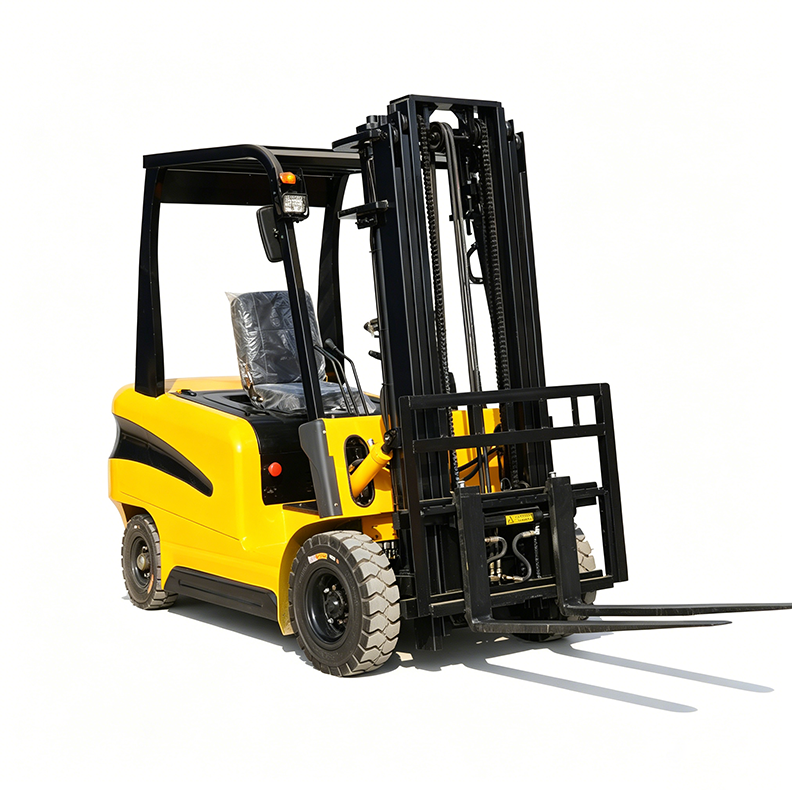
Buying one electric forklift is easy. Buying thirty, fifty, or a hundred units across multiple warehouses is a different game. Lead time slips, battery consistency, spare parts availability, and after-sales response all become visible only after the purchase order lands. A supplier that handles a sample order well may collapse under a bulk schedule. B-end purchasers need a screening process that looks past the quotation sheet and into the production system behind it. The cheapest electric forklift suppliers often hide their real costs in delayed deliveries, mixed component quality, and weak service networks. The goal is not to find the lowest price. The goal is to find a supplier whose process can repeat quality at scale.
The first filter should be compliance documentation. ISO 9001 shows the factory operates a quality management system, but it is only a starting point. CE marking and EU type approvals matter when the forklifts will run in regulated markets. A trading company can also present certificates, so the purchaser needs to verify that the documents match the actual production entity. Ask for the certificate number, the issuing body, and the scope of coverage. Cross-check the factory address on the certificate with the address on the commercial invoice. A mismatch often reveals a middleman adding margin without adding value. The standards exist to create a common baseline. ISO 3691 and ANSI/ITSDF B56.1 define safety and performance requirements for industrial trucks. They do not guarantee a supplier is honest, but they provide a language for comparison.
A supplier can quote a delivery date, but only a factory with real floor space and line depth can hold it. Bulk orders require simultaneous production, not sequential assembly. The key numbers are not just factory size, but how many production lines can run electric forklift models in parallel. A factory with one line can produce twenty units per month. A factory with thirty lines can handle a surge order without pushing other customers aside. Check the number of engineering staff as well. Electric forklifts involve battery integration, controller programming, and safety validation. A strong R&D team indicates the supplier can handle custom voltage requirements or cold storage specifications without farming out the work.
| Screening Criterion | What to Request | Red Flag |
|---|---|---|
| Quality system | ISO 9001 certificate with factory address | Certificate under different legal entity |
| Product compliance | CE certificate, test reports | No test data for electric drive system |
| Production capacity | Number of lines, monthly output records | Vague answers about current backlog |
| Engineering support | R&D team size, customization cases | No in-house battery or controller experience |
| Export experience | List of bulk order destinations | Only sample orders to overseas clients |
The table shows a practical checklist. A supplier that hesitates on any row is not necessarily bad, but the hesitation reveals where risk sits.
For electric forklifts, the battery is not an accessory. It is a major cost driver. Lead-acid and lithium systems behave differently across charge cycles, temperature, and shift patterns. A supplier with strong battery integration experience can explain which chemistry fits a cold storage warehouse or a three-shift operation. Ask for the battery cell source, the BMS brand, and the expected cycle life under your working conditions. The controller is the second risk point. A cheap controller may work on day one, but repeated acceleration and regenerative braking will expose weak programming. Bulk purchasers should request a teardown or a component list before signing. A supplier that hides the battery brand is often hiding the most expensive part of the forklift.
A logistics company in southern China ordered forty electric forklifts for a new distribution hub. The purchase team selected a supplier based on a low quotation and a single demo unit that performed well. The first batch of fifteen units arrived on time, but within a month, three units showed battery voltage drops by mid-shift. The supplier sent replacement batteries, but the replacements came from a different cell batch and did not match the original chargers. The warehouse lost two weeks of full productivity while the electrical team sorted the mismatch. Later inspection showed the supplier had purchased batteries from two different vendors to cut cost. A proper screening would have required a documented battery sourcing policy and a test report from the exact production batch. That experience pushed the company to add component traceability as a mandatory requirement for all future electric forklift suppliers.
The final step is to look beyond the product and examine the manufacturing base. A supplier with a large facility, certified processes, and export experience is more likely to survive a bulk order without cutting corners. Kaiyite, for example, operates a 128,000 square meter factory with 32 production lines and over 1,800 employees, including 390 engineers. Its equipment carries ISO9001 and CE/EU certifications, and products have been exported to more than 120 countries. That scale and certification foundation give B-end purchasers a stronger basis for bulk commitments. A forklift supplier is not just a vendor. It is a production partner that must keep delivering after the first container clears customs.
Shandong Kaiyite Machinery is an important participant in the construction machinery industry, located in a city known for well-known forklift brands such as Komatsu and Toyota. The factory covers an area of 128000 square meters and currently has over 1800employees, including 390 engineers.
Room 1314, 13th Floor, Block B, Zhongde Plaza, Liying Street, Rencheng District, Jining City, Shandong Province
 Wechat QRCode
 WhatsApp
Copyright © 2026 by Shandong Kaiyite Machinery Co., Ltd. Privacy Policy
 EN
EN