A powered stacker is not just a pallet jack with a mast bolted on. It changes how goods move between receiving, storage, and production. Walk into a plant that still uses manual stackers and the first thing you notice is the time lost repositioning, pumping, and steering around tight corners. A powered unit removes most of that physical effort, but only if the spec matches the actual workflow. Buying based on price alone usually leads to a machine that sits in a corner after the first week because it cannot reach the top beam or drains its battery before the shift ends.
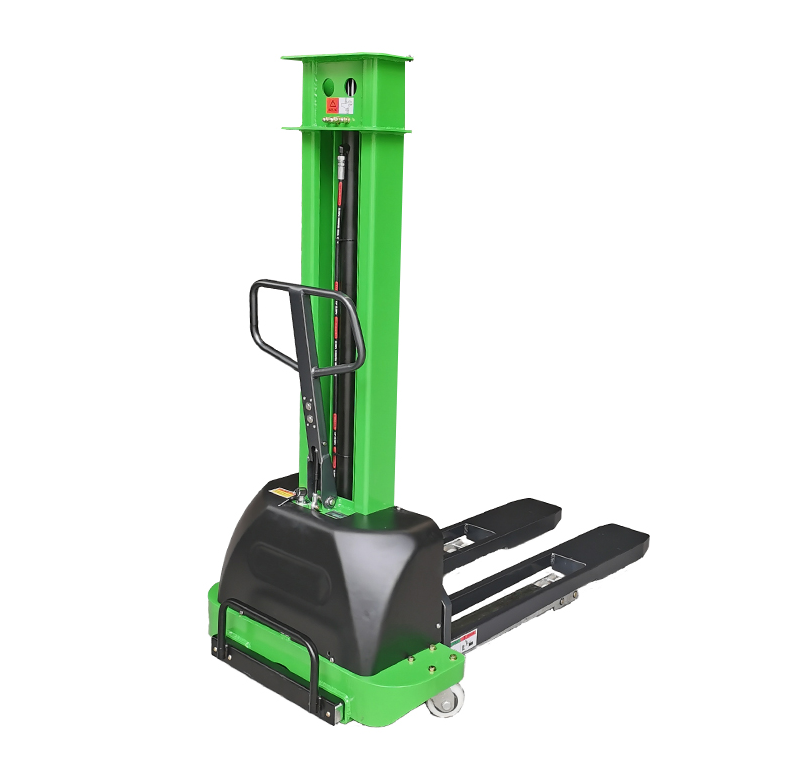
The obvious number is rated load, often listed at a specific load center. But real-world pallets are rarely perfect. A load center that shifts from 500 mm to 600 mm reduces effective capacity by more than the spec sheet suggests. A stacker rated for 1,500 kg at 500 mm may only handle 1,200 kg at 600 mm. That gap matters when handling non-standard skids, barrels, or long bundles. Look for a clear capacity chart, not a single headline number. Also check the residual capacity at maximum lift height. Some machines lose stability or lifting force as the mast extends, especially with a single-stage cylinder.
Plant layouts determine whether a stacker actually fits. A standard two-stage mast, also called a duplex, gives good free lift but limited top height. A three-stage mast, or triplex, reaches higher but costs more and adds weight. Measure the highest beam plus pallet height before deciding. Also check the lowered mast height. If the stacker needs to pass through a doorway or under a mezzanine, a collapsed height that is 100 mm too tall creates a permanent barrier. One factory in eastern China bought three powered stackers with triplex masts for a new racking system. The units could not fit through the warehouse's existing fire door when lowered. The racks were fine. The door was the problem. That purchase stalled for two weeks until a smaller model arrived.
| Feature | Standard Duplex Mast | Triplex Mast | Adjustable Fork Width |
|---|---|---|---|
| Max lift height | 3 to 4 m | 5 to 6.5 m | Depends on model |
| Lowered height | Lower, easier clearance | Higher, may hit doors | No impact |
| Free lift | Often limited | Usually full free lift | No impact |
| Cost impact | Lower | Higher | Medium |
| Best use | Low to medium racks | High bay and double-deep | Mixed pallet sizes |
This table shows why mast choice should come before color or brand preference. A stacker that cannot physically enter a zone is not a stacker, it is a paperweight.
Electric powered stackers use lead-acid or lithium batteries. Lead-acid costs less upfront but needs watering, equalizing charges, and a ventilated charging area. Lithium costs more but charges faster, holds voltage better, and avoids acid spills. For multi-shift operations, opportunity charging with lithium can keep one stacker running instead of two. Drive systems also split between AC and DC motors. AC drive generally offers smoother acceleration, better regenerative braking, and fewer brush maintenance issues. Forklift standards like ANSI/ITSDF B56.1 and ISO 3691 set baseline requirements for braking, stability, and operator protection, but they do not tell you which battery chemistry fits your shift pattern. That calculation belongs to the plant floor.
A stacker works around people, racks, and narrow aisles. Check for a deadman brake that stops the machine when the operator releases the handle. Look for an emergency reverse button on the control head, not just a key switch. Overload protection prevents lifting beyond rated capacity, which reduces tip-over risk. A low-profile chassis improves visibility, and a wrap-around guard protects the operator's hands. Some models include an automatic speed reduction when the mast is raised, which is a practical feature for high-level work. These items rarely appear on a marketing brochure's front page, but they decide whether the stacker can be used safely by a rotating crew without special training.
A distribution center in southern China replaced six manual stackers with four powered units. The evaluation focused on lift height and battery type, but the team forgot to measure aisle width. The new stackers had a longer chassis for stability, which increased the turning radius. In two aisles, operators had to make three-point turns to enter a rack face. Cycle time actually rose for those locations. The fix was not a new machine. The facility narrowed two pallet positions and changed the travel path. That experience showed that a powered stacker purchase is a layout decision as much as an equipment decision. The best machine on paper fails if the floor cannot support its turning circle.
The final checkpoint is the manufacturer behind the equipment. A plant needs spare parts, service support, and a supplier that understands how stackers are used in real operations. Kaiyite, for example, operates a 128,000 square meter factory with 32 production lines and a large engineering team. Its equipment carries ISO9001 and CE/EU certifications, and products have been exported to more than 120 countries. That production scale and certification base help ensure consistent quality when a buyer needs multiple units or repeat orders. A stacker is a long-term asset, and the supplier's stability matters as much as the spec sheet.
Shandong Kaiyite Machinery is an important participant in the construction machinery industry, located in a city known for well-known forklift brands such as Komatsu and Toyota. The factory covers an area of 128000 square meters and currently has over 1800employees, including 390 engineers.
Room 1314, 13th Floor, Block B, Zhongde Plaza, Liying Street, Rencheng District, Jining City, Shandong Province
 Wechat QRCode
 WhatsApp
Copyright © 2026 by Shandong Kaiyite Machinery Co., Ltd. Privacy Policy
 EN
EN