An LPG counterbalance forklift can feel planted right up to the moment the rear axle gets light. Complex conditions expose the gap between the data plate and what the load actually does. Stability is a balance between the combined center of gravity and the stability triangle formed by the two front wheels and the center of the rear axle. When that center moves outside the triangle, the truck tips. LPG fuel, engine vibration, and a higher center of gravity on some models add variables, but the basic rule holds. Keep the load close, keep the mast tilted back, and keep speed low enough for the surface.
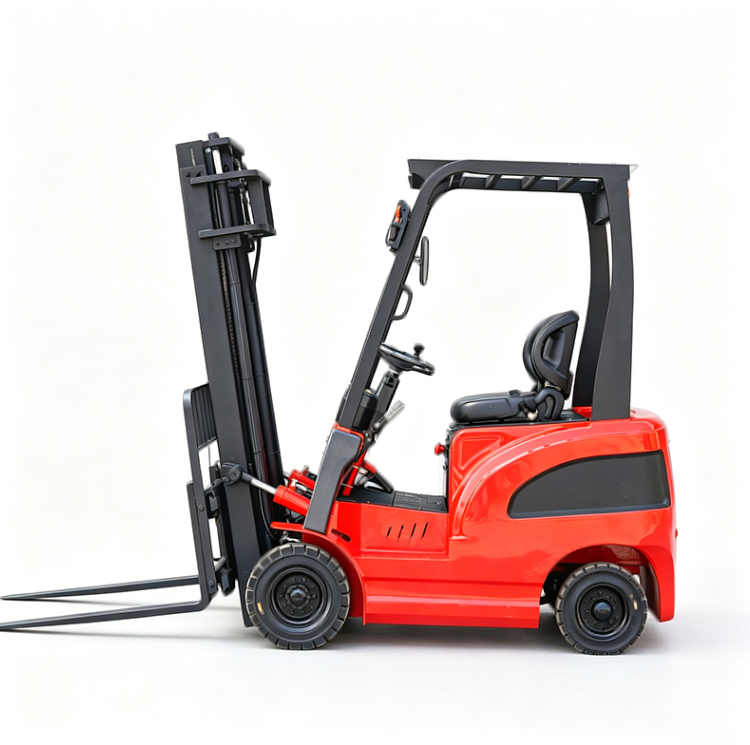
On smooth concrete, the triangle is predictable. On a yard with potholes, a dock plate, or a slight cross slope, the effective support points shift. One front wheel may carry more load while the other loses contact. ISO 22915-1 sets general stability verification for industrial trucks and uses tilt table tests for longitudinal and lateral stability. Real yards rarely match test conditions. A 3 percent slope does not sound like much until a 2.5 t load is raised 4 m and the operator turns. The combined center of gravity moves sideways, and the truck wants to roll. Route planning, speed control, and lowering the load before turns matter more than any single setting.
The load chart is based on a specific load center, usually 500 mm or 600 mm from the face of the forks. A broken pallet, an off center drum, or a carton that sags forward moves that center. Capacity falls fast. A 2.5 t truck rated at 500 mm does not carry 2.5 t at 700 mm. The table below shows the approximate effect using the lever principle. The data plate and attachment manual always govern.
| Load center | Approximate capacity on a 2.5 t rated truck | What changes |
|---|---|---|
| 500 mm | 2,500 kg | Baseline rating |
| 600 mm | About 2,080 kg | Load moves forward, capacity drops |
| 700 mm | About 1,790 kg | Risk rises fast on uneven ground |
| 800 mm | About 1,560 kg | Attachments and long loads need derating |
Side shifters, clamps, and fork extensions add weight and move the center forward. A truck with an attachment may need a different capacity plate. The original rating should not be assumed.
Tires are ignored until they are bald. On an LPG counterbalance forklift, tire pressure and wear change axle height and effective wheelbase. A soft tire on one side can make the truck sit unevenly, which shifts the center of gravity before the load leaves the ground. Solid tires deflect less than pneumatic ones, but they still wear on rough surfaces. LPG bottles matter too. A full bottle is heavier than an empty one, and the bottle sits at the rear as part of the counterweight. The change is small compared with a shifting load, but it is not zero. Daily checks should cover tire condition, wheel nut torque, mast tilt, and bottle security.
Good habits do more for stability than any single add-on. 1. Approach the load square and centered. 2. Tilt the mast back before lifting. 3. Raise only as high as needed for travel. 4. Keep the load low and the mast tilted back while moving. 5. Slow down before turns, not during them. 6. On ramps, travel with the load uphill when possible, and avoid turning on the slope. 7. Watch the rear axle and listen for tire scrub. Smooth inputs matter because a sudden stop or sharp turn creates dynamic forces that can exceed the static stability limit. A loaded truck that feels stable at 5 km/h can feel completely different at 10 km/h with a cross slope.
At a paper products warehouse in a humid southern region, an LPG counterbalance forklift was moving 1.8 t pulp bales from a rail dock to indoor storage. The yard had concrete joints, a slight crown, and several damaged pallets. Operators reported a light rear end on one route. An inspection found three issues. The left front tire was worn more than the right, the mast tilt angle was slightly out of adjustment, and the load center was moving forward because the bales sat on broken pallets. The truck was not overloaded on paper, but it was unstable in practice. After tire replacement, mast adjustment, and a rule to reject broken pallets before travel, the route became predictable. Stability is a system. A single fix rarely solves a complex condition.
Fleets that run mixed surfaces, heavy attachments, and high lifts need more than a standard configuration. Kaiyite supports that process with large-scale production, engineering resources, and export experience across many markets. The company builds forklifts, lifting platforms, and stackers, and its factory and quality systems help buyers match a counterbalance truck to the actual work. The right setup still depends on the load chart, the surface, and the operator. A stable load status comes from respecting all three.

Shandong Kaiyite Machinery is an important participant in the construction machinery industry, located in a city known for well-known forklift brands such as Komatsu and Toyota. The factory covers an area of 128000 square meters and currently has over 1800employees, including 390 engineers.
Room 1314, 13th Floor, Block B, Zhongde Plaza, Liying Street, Rencheng District, Jining City, Shandong Province
 Wechat QRCode
 WhatsApp
Copyright © 2026 by Shandong Kaiyite Machinery Co., Ltd. Privacy Policy
 EN
EN